 7moku
7moku
7moku
7moku
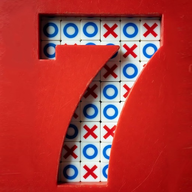
7moku is a two-player abstract strategy game on a 19×19 board, similar to the popular game Gomoku (also called five-in-a-row).
Each turn a player places a 2×2 tile that contains two X's and two O's in one of six fixed patterns.
A player wins by forming seven or more consecutive symbols of their own (horizontal, vertical, or diagonal).
A single placement can complete a line for both players at once - a mutual win.
Researchers are exploring Event Horizon - theoretical endgame positions where every legal move leads to the same outcome. Learn more →
Despite simple rules, 7moku creates very complex positions. Perfect play remains an open research problem.
The goal of 7moku is to be the first player to create an unbroken line of seven of your symbols (either X or O) horizontally, vertically, or diagonally.
The game is played on a 19×19 grid. Players take turns placing 2×2 tiles on the board.
Opening the same player identity in multiple online sessions can interrupt matchmaking. Opening a replay link does not start an online session. While playing online, keep this identity open in one 7moku tab. If a session warning appears, close the other sessions and try again.
MAN is the compact move notation used by 7moku replays and move history.
1. Ta14 Ba11
2. Tc14 Bc11
7moku features global leaderboards where players can compete in Ranked vs Player and eligible Ranked vs Bot games. Local bot Practice and Self-Play games can be saved to history, but they do not change ranked totals.
Ratings start at 0 and change after each ranked game based on the expected result.
The Leaderboard presents verified players and registered bots in separate audiences over the same global Rating pool. Monthly and weekly views include identities active in that concrete UTC period.
Player ratings are updated hourly.
7moku is free to play. Your browser creates a guest profile with its own player identity, name, avatar, and game history. When you are online, that profile and completed games can sync to the cloud without a passkey. Offline games and profile edits stay on this device until their upload succeeds.
Verifying your profile with a passkey makes you eligible for Rating and the player leaderboards. Guest games still save to history. An online game can count for an eligible participant even when the other player is a guest; verification does not recalculate earlier games.
Creating a passkey verifies your existing guest profile and keeps the same player identity and history. Use that passkey to sign in on another phone or computer.
Signing in to an existing profile switches accounts without merging or deleting the one you were using. You can switch between accounts kept on this browser from the Profile page when no game is active. Each account keeps its own device key and game history, including games waiting to sync. My Games shows the selected account's games.
Every ranked game is checked before it counts. Self-Play and local bot Practice can be useful for learning, but they do not increase your ranked score.
My Games saves completed online games, local bot practice, and self-play. It also keeps abandoned rounds with their available moves, without a confirmed winner or Rating effect. If a completed result for that round arrives later, it replaces the abandoned entry in your history.
A saved game keeps each player's displayed name and avatar reference from when the game was saved. Renaming your profile or choosing another avatar does not change those saved details. The artwork at an avatar reference may improve later. Players, live matches, and leaderboards show current profile details.
Saved on this device means the record is in this browser account. Saved to cloud means the upload was accepted. A completed replay becomes available from the replay archive after a separate publication step; cloud acceptance alone does not mean its archive is available.
Replay links include the complete moves and may include a saved game ID. Legal moves play immediately. A matching saved record in your current browser account supplies saved player details without claiming an online confirmed result. Otherwise, the replay checks the archive. A matching online archive can show Online confirmed; a practice archive shows Saved practice. Neither label alone means the game affected Rating. Without a matching record, the moves remain playable with neutral player labels.
Private and practice replays are unlisted: anyone with the link can view them, but they do not appear in public replay discovery. You can share guest, offline, and unsynced games too; another browser may show neutral player labels until the completed archive is available. Screenshots show the board position you are viewing, while screenshot and video QR codes open the complete supplied game.
We store public profile details, such as nickname and avatar, and accepted game records needed for history, replay, and eligible leaderboard scoring. Guest profiles can be stored too. We do not store an email address or password for your 7moku profile.
Your nickname and avatar can be visible in the lobby, matchmaking, live matches, spectator views, and leaderboards when applicable.
Signed game records can be stored for history, replay, fair-play checks, and leaderboards. These records include moves, result when completed, player references, saved names and avatar references, timing, signatures, and game classification. Replay archives contain saved player details, moves, result, and timing; they do not expose signing keys or signatures. 7moku has no chat feature.
We use PostHog browser feature analytics to understand site and feature usage. You can turn feature usage tracking off in Advanced Settings.
To learn more, read our detailed Privacy Policy.